Systems of record · Design-partner preview

Let AI agents act on your systems of record, one authorized action at a time.

Authentication tells you who is calling—not what they may do. Axynd connects an agent’s identity and delegated authority to an exact action, leaves the final decision with the receiving system, and records independently verifiable evidence.

Early access · design partners only. What is proven, and what is not

Illustrative agent request
Who is acting?Procurement agent
Identity
On whose behalf?Requesting organization
Issuer
Delegated scopeOne invoice · Amount limit · Expiry
Scoped
Receiving systemChecks trust and its own policy
Local
Receiving-side decisionAPPROVAL REQUIREDIdentity is not permission. Approval is not execution.
Developer-run result · SAP S/4HANA® 2025

One blocked invoice, released only after approval and a separate Resume.

On September 25, 2026 UTC, a developer-run SAP S/4HANA 2025 CAL validation released one existing blocked supplier invoice through Axynd’s signed approval and separate Resume path. The successful attempt sent one Release POST, returned HTTP 200 with Success=true, and produced an Axynd-signed audit that verified locally.

Review the SAP reference path
  1. A signed request bound the invoice, fiscal year, gross amount, currency and action.

  2. An explicit confirmation became a signed approval. Approval alone made no SAP write.

  3. A separate signed Resume released execution. After a preflight check of the bounded target, the adapter sent one Release POST.

  4. SAP returned HTTP 200 with Success=true. The Axynd-signed receipt and audit verified locally.

Scope: local test signing identities and locally assigned approval roles, not an external identity provider or a separately authenticated finance approver. This was not customer-environment validation, production certification, SAP-signed evidence or a full procure-to-pay validation. No payment, clearing or evidence attachment was performed. The owner subsequently reported no MRBR match across three blocking selections; that is owner-reported follow-up, not an automated read-back. The SAP S/4HANA Cloud Public Edition adapter remains contract-tested; Cloud Public Edition test-tenant validation remains pending.

A separate invoice-exception settlement reference binds versioned terms to an exact action. It is not part of this live SAP result.

Beyond authentication

A known agent is not a blank check.

When an agent requests access to another team’s or organization’s system, a valid identity is only the beginning. The receiver still needs to know who delegated authority, what that authority covers, and whether this exact action is allowed.

Axynd brings those checks together at the configured execution boundary. The receiving organization chooses which issuers to trust, applies its own policy, and retains control of execution. An issuer cannot authorize itself into another organization’s system.

Axynd complements existing identity providers, gateways and systems of record; it does not replace them. Partner-specific identity integration and operational controls remain pilot work, not turnkey integrations.

The trust model

Who acts. Who authorizes. Who decides. What is recorded.

Four questions connect an agent’s identity to a specific request—without turning authentication into automatic permission.

1

Identity

Who is acting, and on whose behalf?

In the transaction reference path, an Agent Passport binds the agent and its key to an issuing organization. The receiver verifies that binding against its configured trust—not an agent’s self-asserted name.

2

Delegated authority

What permission does the agent carry?

A signed Authority Grant limits what the agent may request, for which purpose and validity window. The exact action must fit that delegation; a request cannot give itself broader authority.

4

Verifiable evidence

What decisions and outcomes were recorded?

Signed records bind the request, authority, decision and reported outcome. A reviewer can check supported evidence offline with the private standalone verifier and reviewer-supplied trust.

Trust is a decision, not a badge. A signature authenticates a recorded statement; it does not establish the issuer’s reputation or the truth of a business claim. The receiver decides what to trust and what to permit.

Prototype scope: these are implemented reference paths, not production identity federation or a universal agent credential. Signed evidence does not independently prove physical location, hardware trust or absence of bypass. Review verification limits.

Inside the product · Local prototype

Know the agent. Bound its authority. See what happened.

One workspace connects agent enrollment, reviewed permissions and per-agent activity. Follow an exact request from delegated authority to the receiving system’s decision and recorded outcome.

  1. Enroll the agent

    Check a configured workload identity and possession of the registered signing key. The accountable owner stays administrator-asserted, not independently verified.

  2. Bound its authority

    Review the action, target, amount and expiry before issuing a grant. Revoke an individual grant or suspend the agent; configured receivers enforce the recorded limits.

  3. Keep execution separate

    When policy requires approval, an approver records a decision. A separately authorized Resume releases execution. Approval alone does not write to the protected system.

  4. Review what happened

    Inspect per-agent activity and readable trust reports. Download the original signed audit for independent verification; the readable report is not itself signed.

Control at the configured receiver: managed limits and revocation depend on its connected authority registry. Suspension and revocation stop future dispatch admission; they cannot cancel already-admitted work or undo completed actions.

Locally validated, not production-qualified: this connected workflow uses a signed synthetic identity fixture and mock ERP. It is not a new live Auth0 or SAP test. Live-tenant enrollment and production lifecycle operations remain qualification work.

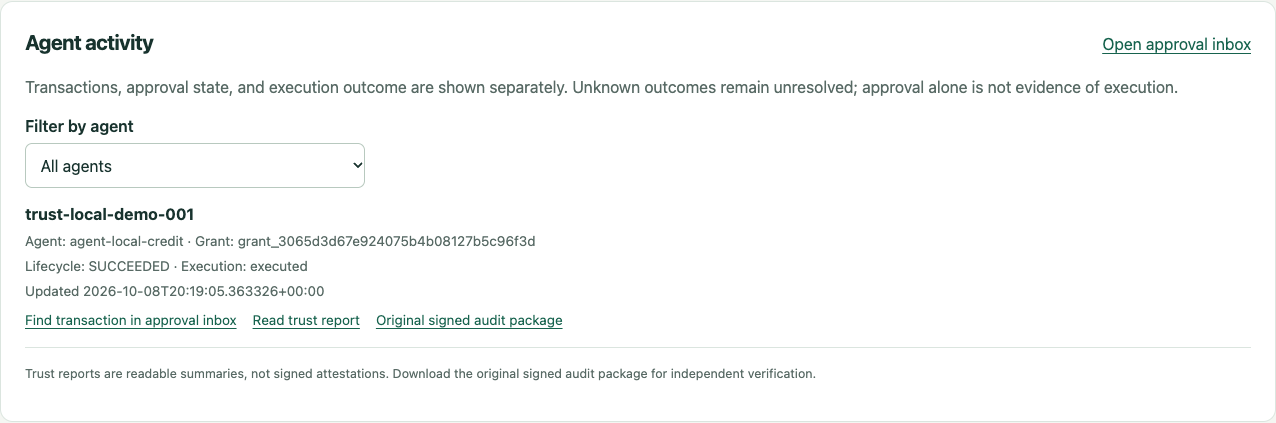
Actual prototype activity view: a synthetic agent transaction succeeded, with separate links to the approval inbox, readable trust report and original signed audit.
Actual local prototype, synthetic test data. Captured October 8, 2026 at 20:19 UTC: one mock credit completed after approval and a separate Resume. This is not a SAP or customer transaction. Select the image to inspect it full-size.
See agent enrollment and permission review in the workspace
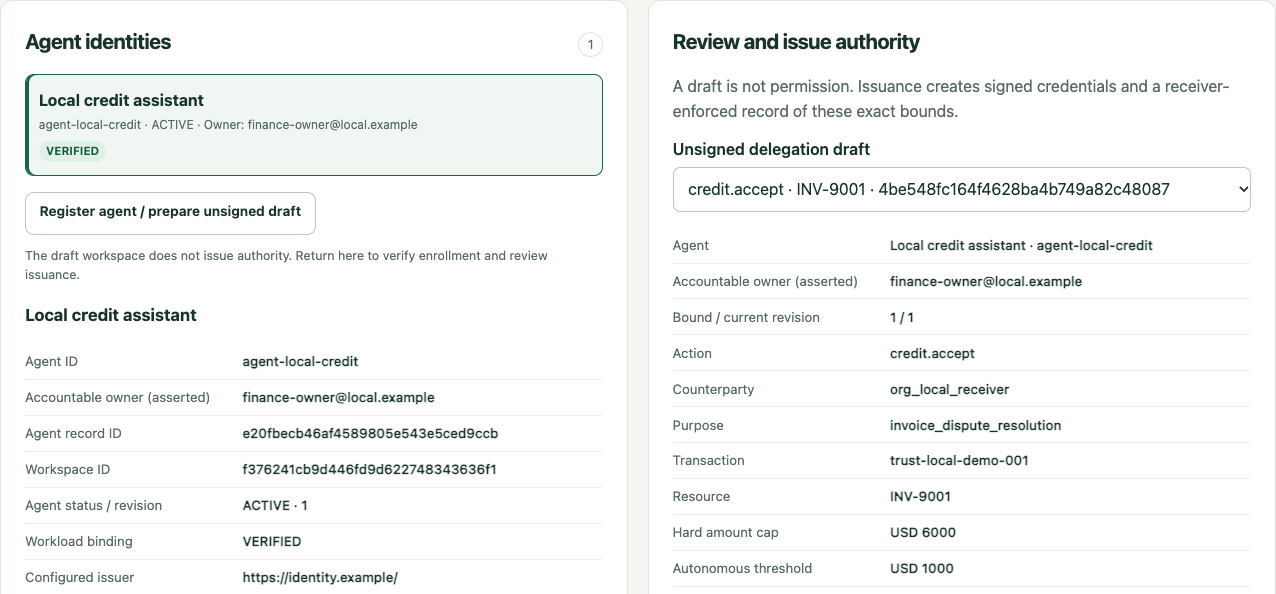
Actual local prototype: verified synthetic workload binding with a reserved example issuer beside a permission draft showing the asserted owner, target, USD 6,000 hard cap and USD 1,000 autonomous threshold.
Same local synthetic run. Identity status is a snapshot at capture time, not a live verification badge. Cropped before the workload subject; expiry is not shown. The owner is asserted; reviewing a draft does not issue authority or execute an action. Select the image to inspect it full-size.
Explore enrollment, lifecycle controls and evidence limits
For the system owner

Approval is not execution. An uncertain write is not retried.

In the business-action reference path, a signed approval changes lifecycle state only; it makes no protected-system write. Only a separately authorized Resume releases that exact transaction.

If the outcome of a dispatched write is ambiguous, the transaction becomes EXECUTION_UNKNOWN. Axynd does not blindly retry an uncertain write. The request, decision, approval, Resume and reported outcome are recorded as signed evidence.

The same authority and evidence model has a separate application to AI inference, where customer policy limits which runtime may execute an invocation. Its controls and validation limits are distinct. Review policy-bound inference

Evidence, not a production claim

What works today. What a pilot must establish.

Working prototype with bounded local validation; seeking enterprise design partners.

The results below test specific identity, authorization and evidence paths. They do not establish a production identity service, universal agent trust, or an independently audited enterprise deployment.

Demonstrated in the prototype
  • Agent and organization binding, scoped delegation, and receiving-side authorization in the transaction reference path.
  • Connected local enrollment, bounded issuance, grant revocation, agent suspension, per-agent activity and audit-backed reports, using a signed synthetic identity fixture and mock ERP.
  • Signed approval and separate Resume in a developer-run SAP invoice release, with locally verified audit evidence.
  • Execution-policy evaluation and signed, runtime-bound decisions.
  • Configured edge enforcement, decision replay rejection, and signed policy distribution.
  • A non-implementing invited evaluator installed the private verifier, verified a signed bundle, and correctly explained its trust limits in 11 minutes 55 seconds with no author help. This was not a security audit or customer validation.
  • A separate Auth0-backed Gemma boundary pilot and follow-on 24-hour qualification with per-round offline evidence verification.
Not yet established
  • Production identity federation, production agent-lifecycle operations or turnkey integration with arbitrary identity providers. The connected local workspace is not live-tenant qualification.
  • Customer-environment acceptance and representative workload quality, latency or throughput.
  • Independently verified runtime platform properties or physical geography.
  • Enforced no-bypass deployment controls and complete data-path confinement.
  • Production tenant isolation, high availability or a managed multi-tenant service.
  • GPU scheduling, model lifecycle management or autonomous failover.
Read the qualification results and experiment-by-experiment limits
24 hoursqualification window
48 / 48synthetic workload rounds passed
2 / 2controlled fault exercises passed
0gateway exception markers recorded
Offlineevidence checked with a private standalone verifier

Single host; one synthetic one-token Gemma round every 30 minutes, September 2026. Measured prototype evidence, not a production SLO or representative load.

Auth0-backed Gemma qualification: an initial developer-run boundary pilot passed on September 13, 2026, followed by a single-host 24-hour qualification completed on September 17, 2026 after 86,401 measured seconds. Using one Auth0 dev application identity, 48 synthetic one-token gemma3:1b workload rounds completed under Axynd delegation and execution-policy checks. All 48 preflights, 48 resource samples and 48 offline evidence verifications passed; both controlled expiry, restart and recovery exercises passed, services stopped cleanly, and zero gateway exception markers were recorded. The run completed 383 logical public-key refreshes from 383 attempts with zero transient failures, so the bounded retry path was not exercised. Earlier boundary tests rejected cross-customer access, model changes and replay, including replay after restart, and separate bounded container-network checks passed. What this run does not show: a live Auth0 outage or signing-key rotation, customer acceptance, an independent audit, a production SLO, representative load, continuous network or hardware attestation, distinct physical locations, or production tenant isolation. Review the identity integration and test limits.

Separate SaaS validation: a two-customer synthetic demo uses in-process HTTP and fake provider transports. Bounded tests cover authenticated customer binding, separate customer keys and state, cross-customer decision rejection, and replay protection. Both demo execution bundles pass customer-aware offline review. This is not a live customer deployment or a real inference run. Its entry point offers simulation-only policy preview; it does not issue signed placement plans or automate recovery.

Local SaaS runtime validation: a separate developer-run acceptance passed on September 13, 2026 UTC (September 12 locally). Two synthetic customers completed one-token invocations against a real local Ollama model over loopback HTTP. Cross-customer access, altered invocations and replay were rejected; both saved execution bundles passed customer-aware offline verification in separate processes. A relay-injected failure produced no call to the secondary tripwire. This was not a model outage, automatic recovery, independent evaluation or customer deployment. Review the validation limits.

Live experiment scope: the recovery run on September 12, 2026 used a preloaded small model and a synthetic one-token invocation across two Kind clusters on one host. This demonstrates logical separation, not distinct physical regions, representative performance or customer validation.

Controlled recovery: signed placement plans used registered attributes and reported runtime health. The separate experiment exercised primary execution, an outage, rejection of an unauthorized target, explicit replanning, and authorized secondary execution. Both successful execution evidence bundles verified with the standalone offline verifier. This does not establish automatic failover.
Enterprise design partners

Bring one agent action you won’t allow today.

Pick one consequential action an AI agent could take in your system of record, such as releasing a blocked supplier invoice, that you would not allow today. Bring its system owner, an engineering owner, a security reviewer and a non-production environment. We’ll define the exact authority, the approval and execution path, the allowed and denied cases, and the evidence your reviewers need.

Start with a discovery conversation. Agree on integration effort, performance expectations and acceptance criteria before a bounded pilot.